Every clear-sky app makes you do the maths yourself: check the moon here, the darkness there, the clouds somewhere else. Almanox does the arithmetic and hands you the answer - a single 0-100 score for tonight, with a one-word grade and a plain-English reason. This chapter explains where that number comes from and how to act on it.
The ring, the grade, and the reason in plain English - the whole night at a glance.
Open the Tonight tab and a ring sweeps up as the score counts to its mark. Beside it sits a one-word grade - Poor, Fair, Good or Excellent - and a headline written the way you would say it yourself: "Bright moon washes out the deep sky". The number tells you how good the night is. The headline tells you what is deciding it. Between the two, you know in three seconds whether to reach for the tripod or the remote.
The score is not a vibe. It fuses four independent measurements - the hours of true astronomical darkness, how much the moon intrudes on that darkness, how high the Milky Way core climbs, and the forecast cloud for the dark window itself. Each one is computed for your exact coordinates and the exact date on screen, and the next section takes them apart one by one.
Beneath the ring, the Local Ephemeris card shows the raw numbers behind the grade: sunset, golden hour, the start of astronomical dark, the moon's phase and illumination percentage, and the Milky Way core rise time Pro. Under those runs a twilight ladder that steps through day, civil, nautical, astronomical and night - so you can watch the sky get dark in stages instead of guessing from sunset, which routinely runs an hour and a half ahead of real darkness.
The sky math on this screen is computed on your device, for your exact location, with no account. The verdict also pulls live cloud cover online to judge tonight.
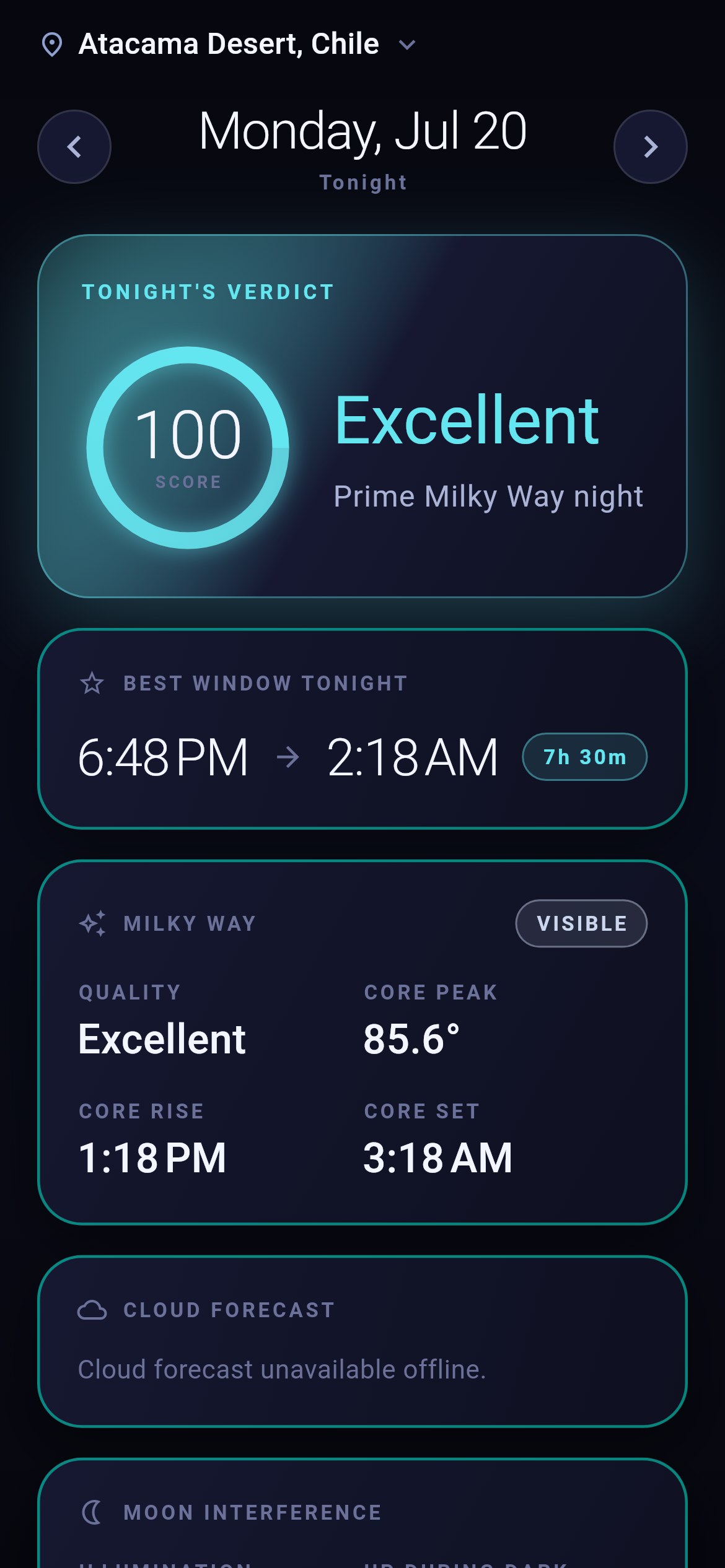
Four measurements, one honest number. When one of them drags the night down, the headline names it.
A single score is only worth trusting if you know what went into it. The verdict weighs four things, and each is measured properly rather than approximated:
Because the inputs stay separate under the hood, the headline can point at the culprit. The same middling score can mean thin cloud over a moonless sky, or a clear sky under a fat gibbous moon - and you would plan those two nights very differently. The verdict tells you which one you are looking at.
What Excellent, Good, Fair and Poor mean in practice, and what to do about each.
The grade is a field recommendation, not a decree. Here is how to act on it:
| Grade | Read it as | What to do |
|---|---|---|
| Excellent | Long true darkness, little or no moon in the window, clear skies | Go. Nights like this are rare enough to commit the drive. |
| Good | A solid dark window with minor interference | Go. Shoot the darkest stretch of the window and work around the rest. |
| Fair | Something is dragging the night down, usually the moon | Maybe. Check the headline and the ephemeris for the culprit before deciding. |
| Poor | Washed out or clouded over | Stay in, or turn the lens on the moon itself - it is the one subject that thrives on a Poor night. |
The verdict is not locked to tonight. Scrub forward to any date and the ring recomputes for that night at your location - which turns a bad forecast into a plan. If tonight is Poor, the next Good night is usually only a few taps away, and you can build the week around it instead of checking the sky every evening and hoping.
When a night reads Fair, look at the moon rows in the ephemeris first. The moon is the usual offender, and unlike cloud it is perfectly predictable - a moonset an hour after dark can turn a Fair evening into a Good late night.
Almanox is a one-time $12.99 purchase - no subscription, no ads, no account. The verdict, the ephemeris and everything behind them run on your device.